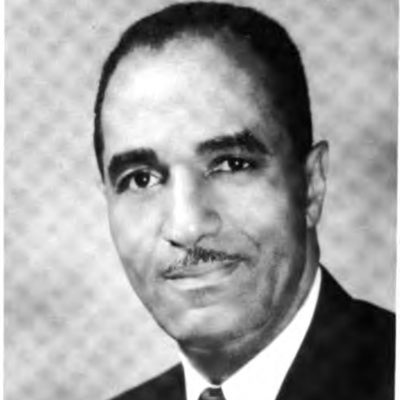
William Benson Bryant
Appointed by President Lyndon B. Johnson in 1965 and confirmed by voice vote, William Benson Bryant was a Judge on the U.S. District Court for the District of Columbia. He earned a law degree from Howard University School of Law in 1936. Rulings & record ↓ Sources ↓
- Lived
- 1911–2005
- Appointed by
- Lyndon B. Johnson, 1965
- Confirmed
- by voice vote
- Chief judge
- District of Columbia, 1977 to 1981
- Education
- Howard 1932 · Howard Law 1936
- Succeeded
- David Andrew Pine
- Succeeded by
- Thomas Francis Hogan
Federal judicial service
| Year | Court | Appointed by | Vote |
|---|---|---|---|
| 1965 | District of Columbia succeeded David Andrew Pine chief judge 1977 to 1981 | L.B. Johnson (D) | Voice vote |
Party letters show the appointing president’s party, not the judge’s own. A voice vote means the chamber approved aloud. No senator-by-senator tally is recorded.
Confirmation vote
Voice vote
The Senate approved this confirmation aloud, with no senator-by-senator tally recorded. Recorded roll-call votes begin in 1989.
Education
| Howard University | A.B. | 1932 |
| Howard University School of Law | LL.B. | 1936 |
Before the bench
Professional career before and outside the federal bench, as recorded by the Federal Judicial Center.
| U.S. Army | 1943-1947 |
| Private practice, Washington, D.C. | 1948-1951, 1954-1965 |
| Assistant U.S. attorney, District of Columbia | 1951-1954 |
| Member, Judicial Conference of the United States | 1977-1981 |
Judicial Record
Caseload & case types
In our data, Bryant was assigned 677 district-court cases (1971–2005). Median time from filing to termination: 477 days across 677 closed cases.
Case assignment is from CourtListener’s PACER-derived docket records: a partial sample, not a complete caseload, reflecting the judge last assigned each case. How we count.
In our data, Bryant authored 84 published opinions for the court (1970–2005). Most cited: Mousa v. Islamic Republic of Iran (80 citations).
A selective record from published opinions in the CourtListener corpus, not every ruling; most unpublished district orders are not included. Counts and rankings are objective and recomputable: how we count. We describe the record, not the judge.
Recent & notable rulings
| Year | Case | Citation | Cited |
|---|---|---|---|
| 2001 | Mousa v. Islamic Republic of Iran | 238 F. Supp. 2d 1 | 80 |
| 1974 | Betesh v. United States | 400 F. Supp. 238 | 45 |
| 1976 | Tax Reform Research Group v. Internal Revenue Service | 419 F. Supp. 415 | 42 |
| 1972 | Hodgson v. United Mine Workers of America | 344 F. Supp. 17 | 37 |
| 1982 | Nunes-Correia v. Haig | 543 F. Supp. 812 | 34 |
| 1976 | Harjo v. Kleppe | 420 F. Supp. 1110 | 33 |
| 1982 | Fitzgerald v. Hampton | 545 F. Supp. 53 | 29 |
| 1989 | United States v. Inslaw, Inc. (Inslaw, Inc.) | 113 B.R. 802 | 27 |
| 1973 | Childs v. United States Board of Parole | 371 F. Supp. 1246 | 27 |
| 1975 | Campbell v. McGruder | 416 F. Supp. 100 | 26 |
| 1979 | United States v. Felt | 491 F. Supp. 179 | 23 |
| 1976 | Smith v. Pro-Football | 420 F. Supp. 738 | 23 |
| 1988 | Alder v. Columbia Historical Society | 690 F. Supp. 9 | 22 |
| 1974 | Sears, Roebuck & Co. v. General Services Administration | 384 F. Supp. 996 | 22 |
| 1983 | Walter O. Boswell Memorial Hospital v. Heckler | 573 F. Supp. 884 | 21 |
Showing the 15 most-cited of 84 authored opinions in our data. “Cited” is inbound citations across the CourtListener corpus. Case links open the ruling’s full text (CourtListener) or its page here; read the methodology and verify against the primary source.
Questions & answers
- Who appointed William Benson Bryant?
- President Lyndon B. Johnson appointed William Benson Bryant to the U.S. District Court for the District of Columbia in 1965.
- Was William Benson Bryant appointed by a Democrat or a Republican?
- William Benson Bryant was appointed by President Lyndon B. Johnson, a Democrat. JudicialFinder records the appointing president's party, not a judge's own politics.
- What was William Benson Bryant's confirmation vote?
- William Benson Bryant was confirmed by voice vote on August 11, 1965. No senator-by-senator tally was recorded.
- Which court was William Benson Bryant on?
- William Benson Bryant was a Judge on the U.S. District Court for the District of Columbia.
Sources
Each fact on this page traces to a primary public record.
- FJC Biographical Directory
- Wikidata
- Portrait: Administrative Office of the United States Courts (Public domain), via Wikimedia Commons
- CourtListener bulk data (Free Law Project): authored opinions & citation counts
How we source & reconcile data → Data & Sources
See something wrong? Report an error. Fixes are logged in the corrections log.
40 years on the U.S. District Court for the District of Columbia. Data as of 2026-09-28. Informational only; verify against the primary source before relying. Not a consumer report (FCRA).