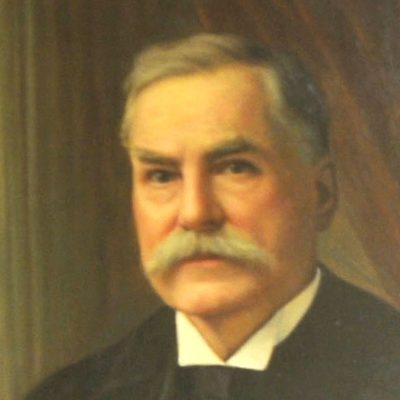
Seth Shepard
Appointed by President Grover Cleveland in 1893 and confirmed by voice vote, Seth Shepard was a Chief Justice on the U.S. Court of Appeals for the District of Columbia Circuit. He earned a law degree from Washington College (now Washington and Lee University) School of Law in 1868. Sources ↓
- Lived
- 1847–1917
- Appointed by
- Grover Cleveland, 1893
- Confirmed
- by voice vote
- Education
- Washington College (now Washington and Lee) Law 1868
- Succeeded by
- Constantine Joseph Smyth
Federal judicial service
| Year | Court | Appointed by | Vote |
|---|---|---|---|
| 1893 | District of Columbia Circuit | Cleveland (D) | Voice vote |
| 1905 | District of Columbia Circuit succeeded Richard Henry Alvey | T. Roosevelt (R) | Voice vote |
Party letters show the appointing president’s party, not the judge’s own. A voice vote means the chamber approved aloud. No senator-by-senator tally is recorded.
Confirmation vote
Voice vote
The Senate approved this confirmation aloud, with no senator-by-senator tally recorded. Recorded roll-call votes begin in 1989.
Education
| Washington College (now Washington and Lee University) School of Law | LL.B. | 1868 |
Before the bench
Professional career before and outside the federal bench, as recorded by the Federal Judicial Center.
| Confederate Army private | 1864-1865 |
| Private practice, Brenham, Texas | 1868- |
| State senator, Texas | 1874-1875 |
| Private practice, Galveston, Texas | -1886 |
| Private practice, Dallas, Texas | 1886-1893 |
| Lecturer in law, Georgetown University | 1895-1910 |
Questions & answers
- Who appointed Seth Shepard?
- President Grover Cleveland appointed Seth Shepard to the U.S. Court of Appeals for the District of Columbia Circuit in 1893.
- Was Seth Shepard appointed by a Democrat or a Republican?
- Seth Shepard was appointed by President Grover Cleveland, a Democrat. JudicialFinder records the appointing president's party, not a judge's own politics.
- What was Seth Shepard's confirmation vote?
- Seth Shepard was confirmed by voice vote on April 15, 1893. No senator-by-senator tally was recorded.
- Which court was Seth Shepard on?
- Seth Shepard was a Chief Justice on the U.S. Court of Appeals for the District of Columbia Circuit.
Sources
Each fact on this page traces to a primary public record.
How we source & reconcile data → Data & Sources
See something wrong? Report an error. Fixes are logged in the corrections log.
24 years on the U.S. Court of Appeals for the District of Columbia Circuit. Data as of 2026-09-28. Informational only; verify against the primary source before relying. Not a consumer report (FCRA).