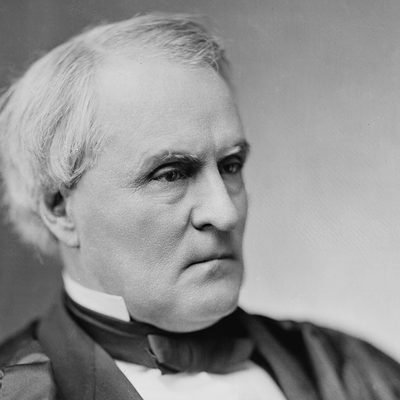
William Strong
Appointed by President Ulysses Grant in 1870 and confirmed by voice vote, William Strong was an Associate Justice of the Supreme Court of the United States. Sources ↓
- Lived
- 1808–1895
- Appointed by
- Ulysses Grant, 1870
- Confirmed
- by voice vote
- Education
- Yale College 1828
- Succeeded
- Robert Cooper Grier
- Succeeded by
- William Burnham Woods
Federal judicial service
| Year | Court | Appointed by | Vote |
|---|---|---|---|
| 1870 | Supreme Court succeeded Robert Cooper Grier | Grant (R) | Voice vote |
Party letters show the appointing president’s party, not the judge’s own. A voice vote means the chamber approved aloud. No senator-by-senator tally is recorded.
Confirmation vote
Voice vote
The Senate approved this confirmation aloud, with no senator-by-senator tally recorded. Recorded roll-call votes begin in 1989.
Education
| Yale Law School | ||
| Yale College | B.A. | 1828 |
| Yale College | M.A. | 1831 |
| Read law | 1832 |
Before the bench
Professional career before and outside the federal bench, as recorded by the Federal Judicial Center.
| Private practice, Reading, Pennsylvania | 1832-1857 |
| U.S. representative from Pennsylvania | 1847-1851 |
| Justice, Supreme Court of Pennsylvania | 1857-1868 |
| Private practice, Philadelphia, Pennsylvania | 1868-1870 |
Questions & answers
- Who appointed William Strong?
- President Ulysses Grant appointed William Strong to the Supreme Court of the United States in 1870.
- Was William Strong appointed by a Democrat or a Republican?
- William Strong was appointed by President Ulysses Grant, a Republican. JudicialFinder records the appointing president's party, not a judge's own politics.
- What was William Strong's confirmation vote?
- William Strong was confirmed by voice vote on February 18, 1870. No senator-by-senator tally was recorded.
- Which court was William Strong on?
- William Strong was an Associate Justice of the Supreme Court of the United States.
Sources
Each fact on this page traces to a primary public record.
- FJC Biographical Directory
- Wikidata
- Portrait: Mathew Benjamin Brady / Levin Corbin Handy (Public domain), via Wikimedia Commons
How we source & reconcile data → Data & Sources
See something wrong? Report an error. Fixes are logged in the corrections log.
10 years on the Supreme Court of the United States. Data as of 2026-09-28. Informational only; verify against the primary source before relying. Not a consumer report (FCRA).