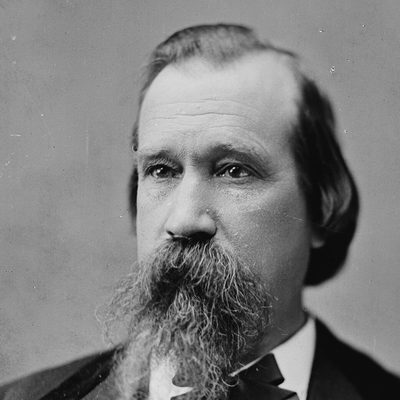
Lucius Quintus Cincinnatus Lamar
Appointed by President Grover Cleveland in 1888 and confirmed by the Senate 32–28, Lucius Quintus Cincinnatus Lamar was an Associate Justice of the Supreme Court of the United States. Sources ↓
- Lived
- 1825–1893
- Appointed by
- Grover Cleveland, 1888
- Confirmed
- 32–28
- Education
- Emory College 1845
- Succeeded
- William Burnham Woods
- Succeeded by
- Howell Edmunds Jackson
Federal judicial service
| Year | Court | Appointed by | Vote |
|---|---|---|---|
| 1888 | Supreme Court succeeded William Burnham Woods | Cleveland (D) | 32–28 |
Party letters show the appointing president’s party, not the judge’s own.
Confirmation vote
The Senate’s published per-senator roll-call records begin in 1989, so no senator-by-senator breakdown is available for this vote.
Education
| Emory College | B.A. | 1845 |
| Read law | 1847 |
Before the bench
Professional career before and outside the federal bench, as recorded by the Federal Judicial Center.
| Private practice, Covington, Georgia | 1847-1849 |
| President, University of Mississippi | 1849-1852 |
| Professor, University of Mississippi | 1849-1852, 1855-1857, 1861, 1865-1870 |
| Private practice, Oxford, Mississippi | 1849-1852, 1855-1857, 1865-1873 |
| Private practice, Covington, Georgia | 1852-1853 |
| State representative, Georgia | 1853 |
| Private practice, Macon, Georgia | 1853-1855 |
| U.S. representative from Mississippi | 1857-1860, 1873-1877 |
| Confederate Army lieutenant colonel, Nineteenth Mississippi Regiment | 1861-1862 |
| Special Confederate commissioner to Russia | 1862-1863 |
| Confederate Army judge advocate, Third Army Corps of the Army of Northern Virginia | 1863-1865 |
| U.S. senator from Mississippi | 1877-1885 |
| Secretary of the Interior | 1885-1888 |
Questions & answers
- Who appointed Lucius Quintus Cincinnatus Lamar?
- President Grover Cleveland appointed Lucius Quintus Cincinnatus Lamar to the Supreme Court of the United States in 1888.
- Was Lucius Quintus Cincinnatus Lamar appointed by a Democrat or a Republican?
- Lucius Quintus Cincinnatus Lamar was appointed by President Grover Cleveland, a Democrat. JudicialFinder records the appointing president's party, not a judge's own politics.
- What was Lucius Quintus Cincinnatus Lamar's confirmation vote?
- The Senate confirmed Lucius Quintus Cincinnatus Lamar 32–28 on January 16, 1888.
- Which court was Lucius Quintus Cincinnatus Lamar on?
- Lucius Quintus Cincinnatus Lamar was an Associate Justice of the Supreme Court of the United States.
Sources
Each fact on this page traces to a primary public record.
- FJC Biographical Directory
- Wikidata
- Portrait: Mathew Benjamin Brady / Levin Corbin Handy (Public domain), via Wikimedia Commons
How we source & reconcile data → Data & Sources
See something wrong? Report an error. Fixes are logged in the corrections log.
5 years on the Supreme Court of the United States. Data as of 2026-09-28. Informational only; verify against the primary source before relying. Not a consumer report (FCRA).